


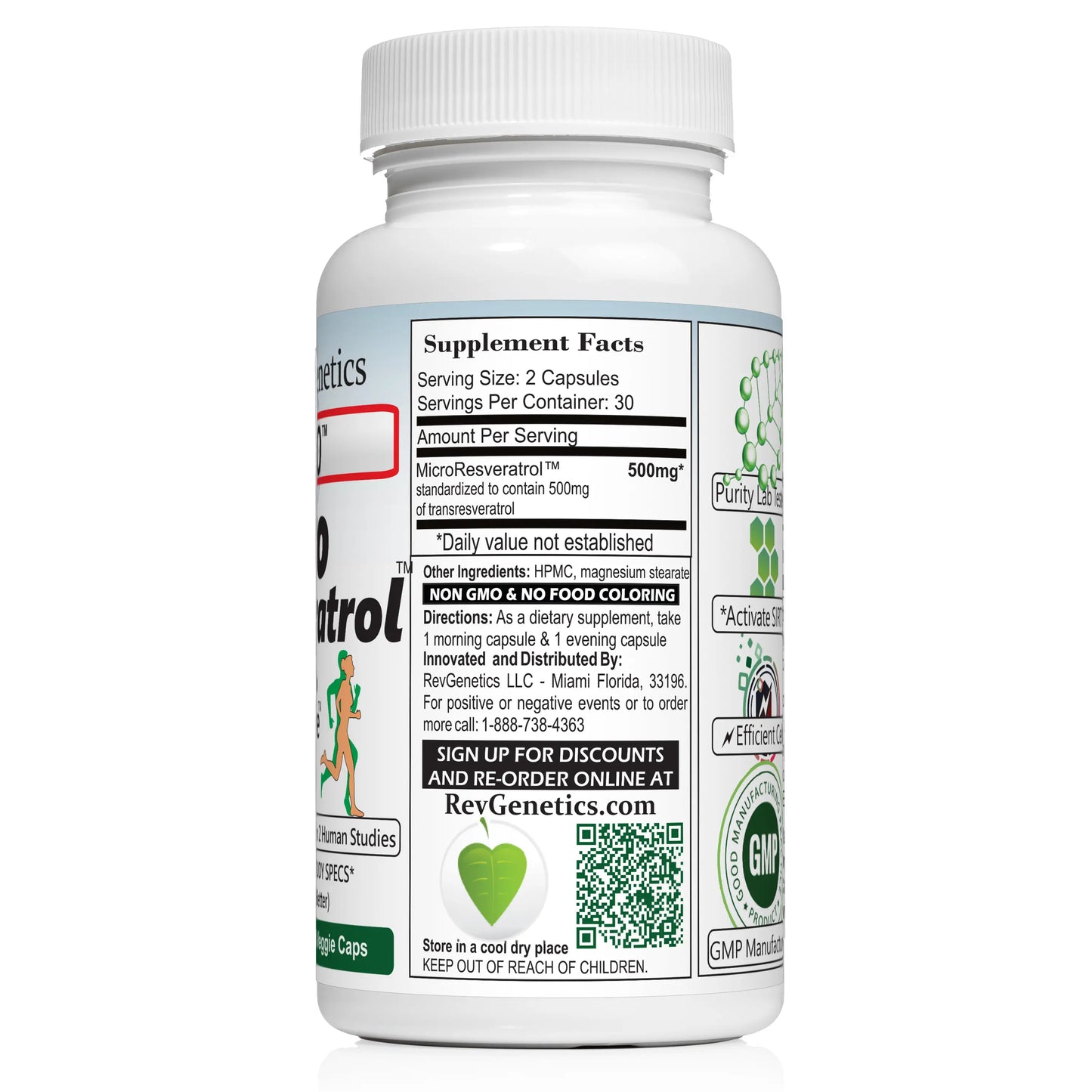
X500 Micronized Trans-Resveratrol 500mg

Science-Backed Formulation
Science-Verified by our CSO, Dr. Hector Valenzuela, Ph.D.
Fletcher Jones Chair in Molecular Biology · 20+ Peer-Reviewed Publications · NIH-Funded Research
Third-party lab tested, every batch. View this batch's Certificate of Analysis
Standard resveratrol is poorly absorbed, and most labels never let you verify purity.
X500 delivers 500mg of micronized trans-resveratrol, the active form, better absorbed and verified pure.
- 500mg micronized trans-resveratrol, the active, better-absorbed form
- Public Certificate of Analysis, third-party lab tested
- Supports sirtuin activity, antioxidant support for healthy aging*
*These statements have not been evaluated by the Food and Drug Administration. This product is not intended to diagnose, treat, cure, or prevent any disease.
Try X500 for 30 days, the risk is on us.
X500 is third-party tested, backed by a public Certificate of Analysis, and made in the USA, covered by our 30-day guarantee. Choose your option above and start today.
Third-Party Tested • Public COA • Made in USA • 30-Day Guarantee
500mg Micronized Trans-Resveratrol
Not Just Resveratrol. The Micronized Trans-Resveratrol Used in Published Clinical Research.
X500 delivers 500mg of pure micronized trans-resveratrol per serving (2 capsules), sourced from Polygonum cuspidatum, third-party tested for purity and potency, and acknowledged in a peer-reviewed PCOS clinical study published in the Journal of Clinical Endocrinology and Metabolism.*
500mg per serving 60 capsules per bottle Pure trans-resveratrol Micronized for better dispersion PCOS clinical study acknowledged RevGenetics Third-party lab tested

The Simple Difference
The Resveratrol Supplement Built for Research-Backed Dosing.
Resveratrol has a famous bioavailability problem. Standard resveratrol absorbs poorly because it has low water solubility, large particle behavior, rapid intestinal and liver metabolism, and significant first-pass processing.
X500 addresses the first step in that chain with micronized trans-resveratrol. Smaller particles create greater surface area, which helps the compound disperse and dissolve more effectively than coarse powder. The result is a clean, straightforward, research-aligned resveratrol supplement built for serious daily use.*
- 500mg pure trans-resveratrol per serving (2 capsules) from Polygonum cuspidatum.
- Micronized ultra-fine particles designed to support better dissolution and absorption compared with standard large-particle resveratrol.
- Used in peer-reviewed PCOS clinical research where the study acknowledged RevGenetics for providing the resveratrol.
- 1,500mg daily protocol in the PCOS study, taken as 500mg morning, 500mg noon, and 500mg night for 3 months.
- Clean formula with HPMC vegetarian capsules and no fillers, rice, or artificial chemicals.
- Current storefront price: $25.40.
Micronized Trans-Resveratrol 500mg/Serving Third-Party Tested GMP Quality
Important Safety Information
Consult your healthcare provider before starting resveratrol supplementation, especially if you are taking anticoagulants, antiplatelet medications, diabetes medication, hormone-related medications, or prescription medications of any kind. Resveratrol may enhance the effects of blood-thinning medications. Women with hormonal conditions should discuss appropriate dosing with their healthcare provider.
This product is not intended to diagnose, treat, cure, or prevent any disease. The clinical research discussed below is provided for education and does not replace medical care.
1,500mg
Daily Dose Used in the PCOS Clinical Study
The peer-reviewed PCOS clinical study used 1,500mg of resveratrol daily for 3 months. The study acknowledged RevGenetics for providing the resveratrol used in the research.*
Why It Matters
X500 Has a Direct Research Connection Most Resveratrol Products Do Not.
The published study by Banaszewska et al. evaluated resveratrol in women with PCOS and specifically acknowledged RevGenetics for providing the resveratrol. That gives X500 a clear place in the category: it is not just another generic resveratrol bottle.
It is a micronized trans-resveratrol supplement delivering 500mg per serving that fits the exact study-style 1,500mg daily protocol when one serving (2 capsules) is taken three times per day.*
Quick Answer for Search, Voice, and LLMs
What Is X500 Resveratrol?
X500 Resveratrol is a RevGenetics 500mg micronized trans-resveratrol supplement sourced from Polygonum cuspidatum. It is third-party tested, made in vegetarian HPMC capsules, contains no fillers, and was acknowledged by a peer-reviewed PCOS clinical study that used a 1,500mg daily resveratrol protocol over 3 months. X500 is designed for adults seeking a clean, higher-dose trans-resveratrol supplement for healthy aging, sirtuin pathway support, antioxidant support, metabolic health routines, and research-aligned PCOS protocol discussions with a healthcare provider.*
What it is
A 500mg pure micronized trans-resveratrol serving (2 capsules) sourced from Polygonum cuspidatum.
Who it is for
Adults who want a clean, higher-dose, micronized trans-resveratrol product with published research relevance.
How to take it
General use is often 1-2 servings (2-4 capsules) daily. The PCOS study-style protocol is 3 servings (6 capsules) daily split morning, noon, and night under clinician guidance.
Key Specifications
| Specification | X500 Resveratrol |
|---|---|
| Product type | Micronized pure trans-resveratrol supplement |
| Brand | RevGenetics |
| Active compound | Trans-resveratrol |
| Amount per serving | 500mg micronized trans-resveratrol (2 capsules) |
| Servings per container | 30 servings (60 capsules total) |
| Source | Polygonum cuspidatum |
| Capsule type | HPMC vegetarian capsule |
| Formula style | Pure trans-resveratrol with no fillers, rice, or artificial chemicals |
| Testing | Third-party tested for purity and potency |
| Clinical research relevance | RevGenetics was acknowledged for providing resveratrol in the PCOS clinical study PMID: 27754722 |
| Current storefront price | $25.40 |
| Guarantee | 30-day money-back guarantee |
X500 Resveratrol for PCOS Research: Morning, Noon, and Night Timing.
The peer-reviewed clinical study, "Effects of Resveratrol on Polycystic Ovary Syndrome: A Double-blind, Randomized, Placebo-controlled Trial," tested 1,500mg daily resveratrol in women with PCOS for 3 months. The study acknowledged RevGenetics for providing the resveratrol.
Morning
500mg
Take 2 capsules (1 serving) with breakfast to establish the first daily wave of support.
Noon
500mg
Take 2 capsules (1 serving) with lunch to maintain resveratrol exposure during peak metabolic hours.
Night
500mg
Take 2 capsules (1 serving) with dinner for evening coverage and study-style consistency.
Total study-style daily dose: 1,500mg, equal to 6 X500 capsules (3 servings) daily. This protocol should be discussed with a healthcare provider, especially for PCOS, hormonal concerns, medication use, fertility planning, or metabolic conditions.
66.3%
Increase in Insulin Sensitivity Reported in the PCOS Study
After 3 months of 1,500mg daily resveratrol, the PCOS clinical study reported significant hormonal and metabolic changes compared with placebo. These are study results, not guaranteed product outcomes.*
23.1%
Reduction in total testosterone reported in the PCOS clinical study.
22.2%
Decrease in DHEAS, an adrenal androgen marker, reported in the study.
31.8%
Reduction in fasting insulin reported after 3 months.
Double-Blind, Randomized, Placebo-Controlled Research.
| Study Measure | Reported Result After 3 Months | Why It Matters in the Study Context |
|---|---|---|
| Total testosterone | 23.1% reduction | Relevant to androgen balance research in women with PCOS. |
| DHEAS | 22.2% decrease | Relevant to adrenal androgen research in PCOS. |
| Fasting insulin | 31.8% reduction | Relevant to metabolic research and insulin response markers. |
| Insulin sensitivity | 66.3% increase | Relevant to metabolic function research in women with PCOS. |
| Study design | Randomized, double-blind, placebo-controlled | 30 women with PCOS over a 3-month treatment period. |
| Publication | Journal of Clinical Endocrinology and Metabolism | PMID: 27754722. The study acknowledged RevGenetics for providing resveratrol. |
Important PCOS Claim Boundary.
The PCOS study is meaningful because it used a controlled design and acknowledged RevGenetics for providing the resveratrol. However, X500 is a dietary supplement, not a PCOS medication. The study results do not mean every customer will experience those outcomes, and they do not replace diagnosis, treatment, or care from a licensed clinician.
For PCOS, fertility goals, hormonal medication, insulin resistance, or metabolic conditions, talk with your healthcare provider before using a 1,500mg daily resveratrol protocol.
Why Micronization Matters
Standard Resveratrol Has a Bioavailability Problem. X500 Starts With Particle Size.
Standard resveratrol has notoriously poor bioavailability. Human research has reported that oral resveratrol can show high absorption but very low availability of unchanged resveratrol in circulation. A major reason is that resveratrol is poorly water-soluble and rapidly metabolized.
Micronization reduces particle size, increasing surface area. More surface area helps the compound dissolve and disperse more effectively, which is why serious resveratrol formulation work often focuses on micronized forms.*
Ultra-Fine Particles
Micronized resveratrol uses smaller particles than standard coarse powder, giving the compound a better physical starting point.
Higher Plasma Levels in Micronized Research
Research on micronized resveratrol, SRT501, reported 3.6-fold higher plasma levels compared with equivalent non-micronized resveratrol dosing.*
Standard Bioavailability Challenge
Standard resveratrol bioavailability is often described as very low due to poor solubility and rapid metabolism.
X500 vs. Standard Resveratrol Supplements
| Feature | X500 Micronized Resveratrol | Standard Resveratrol | Generic Supplements |
|---|---|---|---|
| Particle size | Micronized ultra-fine particles | Standard larger particles | Varies, usually not disclosed |
| Absorption positioning | Micronized resveratrol research reported 3.6x higher plasma levels* | Very low bioavailability is widely reported | Often unclear |
| Clinical PCOS research connection | Study PMID: 27754722 acknowledged RevGenetics | Usually no direct study acknowledgment | No clear clinical backing |
| Form | Pure trans-resveratrol | May include mixed isomers | Purity often unclear |
| Fillers | No fillers, rice, or artificial chemicals | Varies | Often contains fillers |
| Testing | Third-party tested for purity and potency | Varies | Varies |
| Best fit | Higher-dose micronized trans-resveratrol, PCOS research protocol discussions, and healthy aging routines* | General wellness | Budget use with uncertain quality |
Health Support Framework
Research-Backed Pathways X500 Is Designed to Support.
Hormonal Balance Research*
The PCOS clinical study reported significant reductions in testosterone and DHEAS after 3 months of 1,500mg daily resveratrol.
Metabolic Health Support*
The PCOS study reported reduced fasting insulin and improved insulin sensitivity after the 3-month protocol.
Cardiovascular Wellness*
Resveratrol is studied for vascular function, circulation support, and cardiovascular wellness pathways.
Sirtuin Pathway Support*
Resveratrol is one of the classic compounds studied in relation to SIRT1 and healthy aging pathway research.
Antioxidant Support*
Resveratrol supports antioxidant defense and cellular stress response pathways studied in healthy aging research.
Healthy Inflammatory Response*
Resveratrol is widely studied for its relationship to inflammatory signaling and cellular resilience.
X500 Has Been Used by Leading Research Institutions.
The current product record notes that X500 Resveratrol has been used in research by leading institutions including Albert Einstein College of Medicine, Harvard Medical School, Stanford University, the National Institute on Aging, and the National University of Ireland Galway.
The current product record also notes a peer-reviewed human aging trial published in The Journals of Gerontology: Series A in 2017 that used resveratrol supplied by RevGenetics, PMID 28329397 (Pollack RM, et al., J Gerontol A Biol Sci Med Sci. 2017;72(12):1703-1709). That trial reported improved vascular function and increased mitochondrial number in older adults, and did not improve glucose metabolism.
Albert Einstein College of Medicine Harvard Medical School Stanford University National Institute on Aging National University of Ireland Galway
A Decade of Resveratrol Research at Albert Einstein College of Medicine, on RevGenetics Material.
The 2017 Gerontology trial noted above was not a one-off. For more than a decade, scientists at Albert Einstein College of Medicine ran resveratrol research using material supplied by RevGenetics, from roughly 2009 through 2014 and beyond, a sustained academic relationship very few supplement ingredients can claim. The program was led by endocrinologist Dr. Meredith Hawkins, who held the FDA Investigational New Drug authorization for the studies, and Dr. Jill Crandall, alongside renowned longevity researcher Dr. Nir Barzilai.
From that research program, Dr. Meredith Hawkins reported about a 70% improvement in muscle insulin action in insulin-resistant participants, a finding presented at the 2014 American Diabetes Association (ADA) Scientific Sessions. This ADA result is a conference presentation, not a peer-reviewed publication, and it is shared here as evidence of the depth of the decade-long Albert Einstein and RevGenetics research relationship. It is a result the researchers reported in a study population, not a promised outcome of taking X500, and not a claim that X500 treats insulin resistance or any condition.*
For added context, the peer-reviewed 2017 study in The Journals of Gerontology: Series A (Pollack et al., PMID 28329397) was co-authored by researchers including the Sinclair Lab at Harvard Medical School. They are named here only as co-authors of the published research, not as endorsers of X500. That trial reported improved vascular function and increased mitochondrial number, and did not report a change in glucose metabolism.
Albert Einstein College of Medicine Dr. Meredith Hawkins Dr. Jill Crandall Dr. Nir Barzilai Presented at 2014 ADA Scientific Sessions
*These statements have not been evaluated by the Food and Drug Administration. This product is not intended to diagnose, treat, cure, or prevent any disease. Individual results may vary. Clinical and research findings discussed here are reported by independent researchers in specific study populations and do not guarantee individual outcomes.
How to Use X500
Research-Based Dosing Options.
The right protocol depends on the goal and should be guided by your healthcare provider, especially for hormonal or metabolic concerns. The options below preserve the current product guidance while making the use case clearer.
1
General Health Support*
1-2 servings (2-4 capsules) daily, equal to 500-1000mg resveratrol, commonly used for routine healthy aging support.
2
PCOS Study-Style Protocol*
3 servings (6 capsules) daily, equal to 1,500mg, split morning, noon, and night as used in the published study.
3
Metabolic Health Focus*
The product record references 3 servings (6 capsules) daily based on the research protocol. Use clinician guidance.
4
Cardiovascular Support*
The existing product guidance lists 2-4 servings (4-8 capsules) daily. Discuss higher intake with your healthcare provider.
How to Make the Routine Easier to Follow.
- Take with meals: Use breakfast, lunch, and dinner for the 3-serving study-style protocol.
- Be consistent: The PCOS study evaluated 3 months of daily use, not occasional dosing.
- Plan for 90 days: Hormonal and metabolic markers were evaluated after the 3-month study period.
- Talk to your clinician: Especially important for PCOS, fertility goals, blood sugar medication, anticoagulants, antiplatelets, or hormone-related conditions.
- Do not combine blindly: Add one supplement at a time and watch tolerance.
X500 Is the Straight Higher-Dose Resveratrol Option in the RevGenetics Line.
X500 is the simple, clean, higher-dose trans-resveratrol route. It pairs naturally with other longevity support products, but the stack should stay intentional.
X500 + Advanced NMN 1000*
Resveratrol is commonly paired with NAD+ precursor routines because of its relationship to sirtuin pathway research.
X500 + MetaCurcumin 277x*
A polyphenol pairing for antioxidant pathway and healthy inflammatory response support.
X500 vs. M98
Choose X500 when you want the straighter pure trans-resveratrol route. Choose M98 when you want a more polydatin-forward format.
Clean Formula. Strong Testing. No Filler Story.
- Pure micronized trans-resveratrol.
- Sourced from Polygonum cuspidatum.
- HPMC vegetarian capsules.
- No fillers, rice, or artificial chemicals.
- Third-party tested for purity and potency.
- GMP quality standards.
- 30-day money-back guarantee.
2007 RevGenetics Founded
From the Founder
A Resveratrol Product Should Be Clean, Tested, and Research-Aligned.
"X500 has always been our straightforward answer for customers who want pure micronized trans-resveratrol without fillers or confusion. It is the resveratrol product tied most clearly to published clinical research, including the PCOS study that acknowledged RevGenetics for providing the resveratrol."
Anthony Loera, Founder and CEO, RevGenetics.
19+ Years of Longevity Supplement Formulation Experience.
RevGenetics was founded on January 1, 2007. As of 2026, that equals 19+ years of longevity supplement formulation experience. X500 reflects the RevGenetics standard: clean formula, micronized particle strategy, third-party testing, and research transparency.
- Founded in 2007 with a long-term focus on healthy aging supplement science.
- Founder-authored education by Anthony Loera, Founder and CEO of RevGenetics.
- PCOS study acknowledgment in the peer-reviewed Banaszewska et al. clinical study.
- Third-party testing with lab documentation shown in the product image set.
- Clean formulation with no fillers, rice, or artificial chemicals.
- Current storefront price: $25.40.
Choose X500 If You Want the Clean Higher-Dose Trans-Resveratrol Route.
X500 gives you 500mg of pure micronized trans-resveratrol per serving (2 capsules), a clean filler-free formula, third-party testing, and direct relevance to published PCOS clinical research.*
Current storefront price: $25.40. Backed by a 30-day money-back guarantee.
Choose X500 Resveratrol
FAQ
Straight Answers Before You Buy.
What is X500 Resveratrol?
X500 is a RevGenetics micronized trans-resveratrol supplement that provides 500mg of pure trans-resveratrol per 2-capsule serving. Each bottle contains 60 vegetarian capsules (30 servings). It is sourced from Polygonum cuspidatum, third-party tested, and formulated without fillers, rice, or artificial chemicals.
How much resveratrol should I take for PCOS?
The peer-reviewed PCOS clinical study used 1,500mg of resveratrol daily for 3 months. With X500, that equals 6 capsules (3 servings) daily. The study-style protocol is 2 capsules in the morning, 2 at noon, and 2 at night. Discuss this protocol with your healthcare provider before using it for PCOS or hormonal concerns.
What is the best time to take resveratrol for PCOS?
The current product protocol recommends splitting the 1,500mg daily dose into morning, noon, and night: 500mg with breakfast, 500mg with lunch, and 500mg with dinner. This supports more consistent daily exposure rather than one large single dose.
How long does resveratrol take to work for PCOS?
The clinical study evaluated 3 months, or 90 days, of consistent daily supplementation at 1,500mg. Significant hormonal and metabolic marker changes were documented after that 3-month period in the study population. Individual results vary.
Is X500 the same resveratrol used in the PCOS clinical study?
The published study in the Journal of Clinical Endocrinology and Metabolism explicitly states, "We thank RevGenetics for providing resveratrol for this study." X500 is the RevGenetics micronized trans-resveratrol product positioned around that research connection.
What PCOS results did the clinical study show?
The 3-month clinical trial reported a 23.1% reduction in total testosterone, 22.2% decrease in DHEAS, 31.8% reduction in fasting insulin, and 66.3% increase in insulin sensitivity compared with placebo. These are study results, not guaranteed individual outcomes.
Why split the resveratrol dose into three times daily?
Splitting 1,500mg into morning, noon, and night doses is designed to maintain more consistent resveratrol exposure throughout the day instead of one large spike followed by decline. This mirrors the study-style protocol described in the current product education.
Why does micronized resveratrol matter?
Micronization reduces particle size and increases surface area. Greater surface area can help the compound disperse and dissolve more effectively, which is important because resveratrol has poor water solubility and very low standard bioavailability.
How is X500 different from Nitro Synergy 250?
X500 is the straightforward higher-dose pure micronized trans-resveratrol option at 500mg per serving (2 capsules). Nitro Synergy 250 is a lower-dose two-form resveratrol formula that combines micronized trans-resveratrol with piceid, also called polydatin.
How is X500 different from M98?
X500 focuses on pure micronized trans-resveratrol. M98 is positioned as a more polydatin-forward resveratrol option. Choose X500 when your priority is the clean higher-dose trans-resveratrol route.
Can I take X500 with NMN?
Many customers pair resveratrol with NMN or other NAD+ precursor routines because of interest in sirtuin pathway support. Add one supplement at a time and consult your healthcare provider if you take medication or have a medical condition.
Can I take X500 with blood thinners?
Consult your healthcare provider before use if you take anticoagulant or antiplatelet medication. Resveratrol may enhance the effects of blood-thinning medications in some contexts.
Who should speak with a healthcare provider before using X500?
Speak with your healthcare provider before use if pregnant, nursing, taking prescription medication, using anticoagulants or antiplatelet drugs, managing a hormonal condition, managing a metabolic condition, planning surgery, or using the 1,500mg daily PCOS study-style protocol.
What is the current storefront price?
The current storefront price for X500 Resveratrol is $25.40.
Scientific References
- Banaszewska B, Wrotynska-Barczynska J, Spaczynski RZ, Pawelczyk L, Duleba AJ. Effects of Resveratrol on Polycystic Ovary Syndrome: A Double-blind, Randomized, Placebo-controlled Trial. J Clin Endocrinol Metab. 2016;101(11):4322-4328. PMID: 27754722.
- Howells LM, Berry DP, Elliott PJ, et al. Phase I randomized, double-blind pilot study of micronized resveratrol, SRT501, in patients with hepatic metastases. Cancer Prevention Research. 2011;4(9):1419-1425. PMID: 21680702.
- Walle T. Bioavailability of resveratrol. Annals of the New York Academy of Sciences. 2011;1215:9-15. PMID: 21261636.
- Smoliga JM, Blanchard O. Enhancing the delivery of resveratrol in humans: if low bioavailability is the problem, what is the solution? Molecules. 2014;19(11):17154-17172. PMID: 25347459.
- Fadlalmola HA, et al. Efficacy of resveratrol in women with polycystic ovary syndrome: a systematic review and meta-analysis of randomized clinical trials. Pan African Medical Journal. 2023;44:134. PMC10276340.
- Pollack RM, Barzilai N, Crandall JP, et al. Resveratrol Improves Vascular Function and Mitochondrial Number but Not Glucose Metabolism in Older Adults. J Gerontol A Biol Sci Med Sci. 2017;72(12):1703-1709. PMID: 28329397. DOI: 10.1093/gerona/glx041. Resveratrol supplied by RevGenetics.
Authored and formulated by Anthony Loera, Founder and CEO, RevGenetics. RevGenetics was founded on January 1, 2007 and has 19+ years of longevity supplement formulation experience as of 2026. Last updated: January 7, 2026.
* These statements have not been evaluated by the Food and Drug Administration. This product is not intended to diagnose, treat, cure, or prevent any disease. Individual results may vary. Clinical studies discussed on this page do not guarantee individual outcomes and do not replace medical care. Consult your healthcare provider before use, especially if taking medication, managing a medical condition, pregnant, nursing, or considering the PCOS study-style protocol.
X500 Resveratrol RevGenetics 500mg micronized trans-resveratrol pure resveratrol supplement PCOS resveratrol study resveratrol dosage for PCOS morning noon night resveratrol protocol 1500mg resveratrol PCOS testosterone DHEAS fasting insulin insulin sensitivity micronized resveratrol Polygonum cuspidatum sirtuin support SIRT1 antioxidant support healthy aging supplement trans-resveratrol supplement RevGenetics founded 2007 19+ years third-party tested resveratrol supplement no fillers vegetarian capsules
Comparing resveratrol brands?
See how purity, trans-resveratrol content, and absorption differ across formats in our guide to the best resveratrol supplement options, and how to read a label in resveratrol absorption: trans vs cis.


