


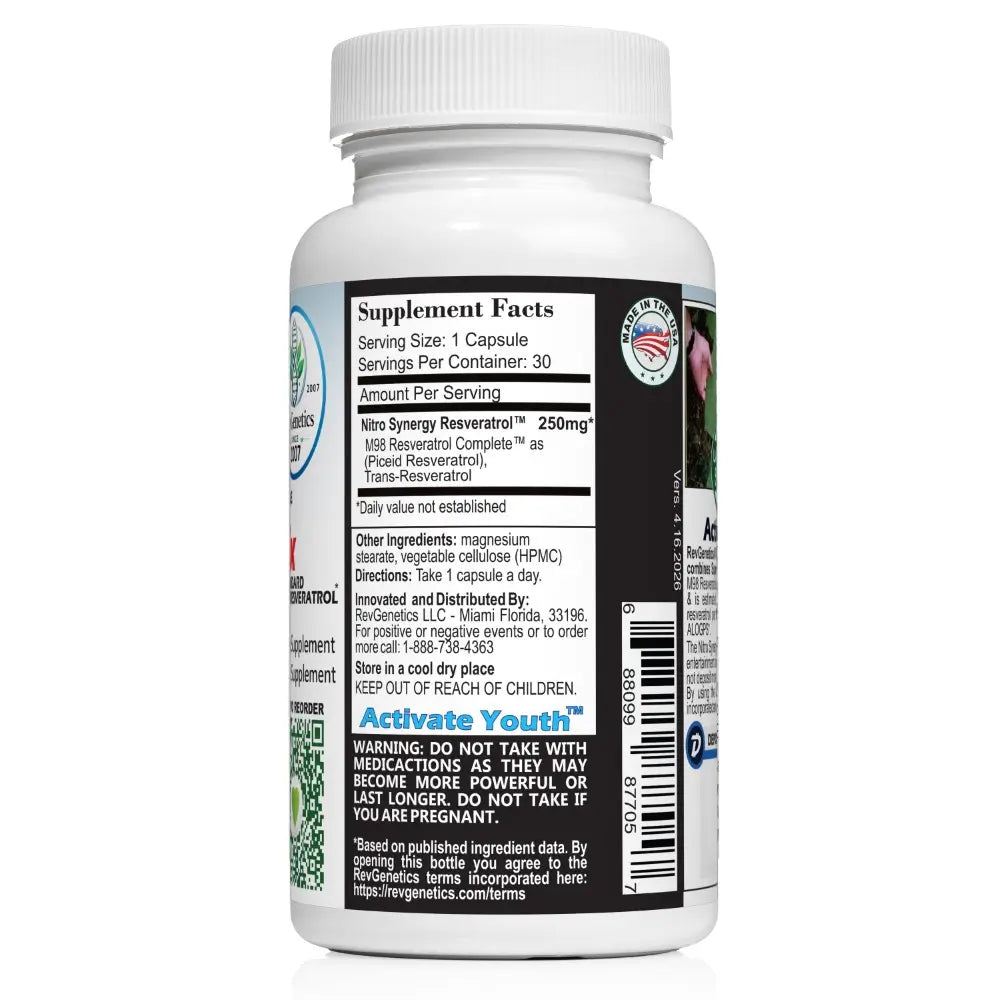

Not Just Resveratrol. A Smarter Two-Form Delivery Capsule.
Nitro Synergy 250 pairs micronized trans-resveratrol with piceid, also called polydatin, in a rapid-breakup vegetarian capsule designed for cleaner dispersion, better formulation logic, and a smarter daily longevity routine.*
Your Resveratrol Should Not Have to Fight Its Own Formula.
Most resveratrol products try to win with a larger number on the label. Nitro Synergy 250 takes a smarter route. It combines a micronized free form with piceid, a water-soluble glucoside form of resveratrol, so the capsule is built around dispersion, solubility, and practical daily use instead of milligram theater.
- Micronized trans-resveratrol helps improve surface area for cleaner dispersion and dissolution support.*
- Piceid, also called polydatin, adds a water-soluble glucoside form of resveratrol with a different preclinical intestinal transport profile.
- Rapid-breakup capsule design helps the formula release and disperse cleanly after swallowing.
- 250mg per vegetarian capsule gives you a lean, convenient resveratrol option for daily use.
- 30-day satisfaction guarantee gives customers confidence when trying the formula.
Greater Water Solubility for Piceid
Published solubility baselines put piceid near 0.5 mg/mL, compared with common trans-resveratrol baseline ranges around 0.015 to 0.05 mg/mL. Using 0.02 mg/mL as a practical midpoint gives the 25x solubility comparison.
Less Clumping. Cleaner Dispersion. A Smarter Pathway.
Standard trans-resveratrol is lipophilic and poorly water-soluble. That means it can clump in the digestive tract, which limits the opportunity for uptake. Nitro Synergy 250 addresses that problem by pairing micronized trans-resveratrol with piceid, a more water-soluble resveratrol glucoside that can convert back to resveratrol in vivo.
You are not buying a smaller resveratrol capsule. You are buying a more deliberate one.
What Is Nitro Synergy 250?
Nitro Synergy 250 is a RevGenetics micronized resveratrol supplement that combines 250mg of micronized trans-resveratrol plus piceid, also called polydatin, in a rapid-breakup vegetarian capsule. It is designed for adults who want a formulation-first resveratrol option focused on dispersion, solubility, and daily healthy aging support.*
What it is
A two-form resveratrol capsule with micronized trans-resveratrol plus piceid, also known as polydatin.
Who it is for
Adults who want more than a plain single-form resveratrol capsule and prefer a smarter daily format.
How to take it
Start with 1 capsule daily, taken with or after a meal that contains fat, unless your clinician recommends otherwise.
Key Specifications
| Feature | Nitro Synergy 250 |
|---|---|
| Product type | Micronized resveratrol capsules |
| Brand | RevGenetics |
| Format | 30 vegetarian capsules |
| Active amount | 250mg per capsule |
| Core forms | Micronized trans-resveratrol plus piceid, also called polydatin |
| Capsule focus | Rapid breakup and dispersion support for a formulation-first oral-delivery approach* |
| Suggested use | Start with 1 capsule daily, taken with or after a meal that contains fat |
| Guarantee | 30-day satisfaction guarantee |
| Use notes | Talk to your physician before use if you are pregnant, nursing, taking medication, or managing a medical condition. Resveratrol can interact with anticoagulants, antiplatelet drugs, and other medications. For oral use only. |
Most Resveratrol Products Ignore the Hard Part.
Resveratrol has decades of research behind it, but standard oral delivery remains a challenge. Human research has reported high absorption paired with very low availability of unchanged resveratrol in circulation. That makes the real question simple: did the capsule respect the delivery problem, or did it ignore it?
Micronized Free Form
Micronized trans-resveratrol gives the capsule a faster-dispersing free form with more surface area than coarse powder. That matters because particle behavior affects how well a compound can disperse and dissolve.
Piceid / Polydatin
Piceid is the glucoside form of resveratrol. Its glucose molecule changes how the compound behaves in water and gives the formula a second resveratrol-family pathway instead of relying on one plain powder alone.
Rapid Breakup
A capsule still has to open, release, and disperse. Nitro Synergy 250 uses a rapid-breakup approach to help the formula start cleanly after swallowing.
Built Around the Resveratrol Delivery Problem.
1. Micronized trans-resveratrol for dispersion and dissolution
Micronization is not a marketing flourish. Smaller particles create more surface area, and more surface area gives a compound a better shot at dispersing and dissolving. That matters for resveratrol because poor aqueous behavior is one reason the category keeps relying on large label numbers instead of better formulation.
In Nitro Synergy 250, micronized trans-resveratrol is the anchor. It keeps the capsule grounded in the resveratrol form most buyers recognize while giving the powder a better physical starting point than coarse material.
2. Piceid, also called polydatin, changes the formula
Piceid is the glucoside form of resveratrol. The attached glucose molecule is not a small detail. It makes piceid more water-soluble than free resveratrol and gives the formula a second resveratrol-family form with its own handling advantages.
Research has reported a different intestinal transport profile for trans-piceid in Caco-2 cell models, and in vivo work has documented mutual transformation between polydatin and resveratrol. That is why piceid is not label decoration. It changes how the product is built.
3. Rapid-breakup capsule design helps the formula start sooner
A formula cannot perform well if it does not release and disperse cleanly. Nitro Synergy 250 uses a rapid-breakup capsule approach because the powder needs a clean start after swallowing.
Rapid breakup does not mean instant absorption. It means the capsule is designed to release and disperse efficiently, giving the formula a better early step in the oral-delivery chain.
4. A leaner 250mg capsule can be the smarter choice
No one is claiming 250mg is automatically better than 500mg. Dose matters. But the best dose is the one matched to a formula that makes sense, a routine you can stay consistent with, and a price that does not punish daily use.
Nitro Synergy 250 is for the buyer who wants a mixed-form resveratrol capsule with micronized trans-resveratrol, piceid, rapid-breakup capsule design, and a practical daily format.
Two-Form Resveratrol in One Daily Capsule
Each vegetarian capsule combines micronized trans-resveratrol with piceid, creating a formula built for people who care about how resveratrol is delivered, not just how much is printed on the label.
Vegetarian capsules per bottle.
Resveratrol-family forms: micronized trans-resveratrol and piceid.
Simple daily capsule routine.
Designed for a Smarter Healthy Aging Routine.
-
Supports a smarter resveratrol delivery strategy*
Nitro Synergy 250 combines micronized trans-resveratrol, piceid, and rapid-breakup capsule design so the formula addresses surface area, mixed-form composition, and dispersion in one product. -
Supports antioxidant activity and healthy cellular stress response*
Resveratrol is one of the most studied compounds in the healthy aging category. Nitro Synergy 250 keeps the familiar resveratrol activity proposition while improving the formulation approach. -
Supports consistency in a daily routine*
One capsule daily is easy to understand, easy to repeat, and easier to maintain than complicated resveratrol stacks. -
Supports buyers who want more than a plain single-form capsule*
If you want a piceid resveratrol supplement with micronized trans-resveratrol in the same capsule, Nitro Synergy 250 gives you a cleaner answer.
Nitro Synergy 250 vs. X500 vs. M98
Nitro Synergy 250 has a clear role in the RevGenetics resveratrol line. X500 is the straightforward higher-dose pure trans-resveratrol option. M98 leans harder into polydatin. Nitro Synergy 250 sits in the middle for buyers who want both micronized trans-resveratrol and piceid in one daily capsule.
| What You Are Comparing | Nitro Synergy 250 | X500 Resveratrol | M98 Resveratrol Complete |
|---|---|---|---|
| Main reason to choose it | You want more than a plain one-form resveratrol capsule. | You want a simpler higher-dose pure trans-resveratrol capsule. | You want a more polydatin-centered option. |
| Formula style | Mixed-form capsule with micronized trans-resveratrol plus piceid. | Single-form capsule with micronized trans-resveratrol. | Polydatin / piceid emphasis. |
| Dose approach | 250mg per capsule with a formulation-led design. | Higher-dose single-form approach. | Alternative format for buyers focused on polydatin. |
| What it emphasizes | Micronized free-form resveratrol, more water-soluble piceid, and rapid capsule breakup.* | Pure micronized trans-resveratrol and label strength. | Polydatin emphasis. |
| Best fit | Buyers who want to move beyond simple one-form resveratrol without leaving the convenience of a daily capsule. | Buyers who want the cleanest straight-line pure trans-resveratrol route. | Buyers who specifically want a piceid-forward approach. |
Pick Nitro Synergy 250 when you want micronized trans-resveratrol plus piceid in one capsule. Pick X500 when your priority is the straighter higher-dose single-form route. Pick M98 when you specifically want a polydatin-forward format.
Made for Buyers Who Already Know Bigger Is Not Always Smarter.
Nitro Synergy 250 is for people who want a high-quality micronized resveratrol capsule instead of a generic antioxidant blend. It is also for shoppers comparing Nitro Synergy 250 against X500 and asking whether absorption strategy matters more than a bigger single-form milligram number.
- Buyers searching for a high-quality micronized resveratrol capsule.
- Shoppers who want both trans-resveratrol and piceid in a single capsule.
- People comparing Nitro Synergy 250 against X500 and M98.
- Users who prefer capsule convenience over loose powder.
- Customers building a healthy aging routine who want a resveratrol-with-polydatin option that is easy to take every day.*
Nitro Synergy 250 is probably not your first pick if your only buying rule is maximum single-ingredient dose per capsule. In that case, a pure higher-dose route may fit you better. Nitro Synergy 250 is for the buyer who respects formulation design enough to care how the product is built.
Simple Daily Use.
Take 1 Capsule Daily
Start with 1 capsule daily unless your clinician recommends a different protocol.
Use With Food
Take with or after a meal that contains fat. This is practical because resveratrol is lipophilic.
Stay Consistent
Nitro Synergy 250 is not a stimulant. Use it consistently as part of your healthy aging routine.*
This Is Not a Same-Day Jolt. It Is a Better Resveratrol Strategy.
Nitro Synergy 250 was not designed around a dramatic same-day feeling. The value is in the formulation, the daily usability, and the rationale for how the capsule is put together.
Think of it this way: Nitro Synergy 250 is about absorption strategy and formulation quality in a practical capsule. You are getting micronized trans-resveratrol, piceid, and rapid-breakup capsule design in a 250mg format that is easy to use daily.
Resveratrol is one of the most talked-about ingredients in healthy aging, but the literature still treats oral bioavailability as a real challenge. Nitro Synergy 250 does not pretend that problem is solved by a bigger label number. It responds with a more serious capsule design.
The Bridge Option in the RevGenetics Resveratrol Line.
Nitro Synergy 250 slips easily into a daily healthy aging stack built around consistency and capsule convenience. Buyers often pair resveratrol products with NAD+ pathway support, antioxidant staples, or other longevity-focused supplements, but the cleanest advice is still to keep the stack simple, add one variable at a time, and watch tolerance.
Inside the RevGenetics line, Nitro Synergy 250 works as the bridge option. It is more layered than a plain single-form capsule and more convenient for buyers who want micronized trans-resveratrol and piceid together.
If you take prescription medication, live with a medical condition, or use a large supplement stack, check compatibility with your clinician first. This is especially important if anticoagulant or antiplatelet drugs are part of your regimen.
The Science Behind the Solubility Advantage
Piceid is structurally related to resveratrol, but with a natural glucose molecule attached. That sugar moiety enables stronger water interaction, which helps explain why piceid is reported as more water-soluble than standard trans-resveratrol.
mg/mL reported baseline range for standard trans-resveratrol aqueous solubility in pre-formulation literature.
mg/mL approximate published water solubility figure for piceid / polydatin.
Potential multiplier when measured against the lowest 0.015 mg/mL baseline figure.
Standard trans-resveratrol is famously lipophilic, meaning it resists dissolving in water. Because it resists water, it can clump in the digestive tract, and absorption can take the hit.
Piceid, also called polydatin, adds a natural glucose molecule to the resveratrol structure. That structural difference supports better water interaction, cleaner dispersion in the GI tract, and a more serious delivery route than a single-form standard resveratrol capsule.
The practical math is simple: 0.50 mg/mL piceid divided by 0.02 mg/mL standard resveratrol equals 25x greater solubility. Measured against 0.015 mg/mL, the gap rises to about 33x.
Built for Buyers Who Care How the Capsule Works.
RevGenetics has focused on resveratrol and healthy aging supplements since 2007. Nitro Synergy 250 reflects that category experience by giving buyers a distinct formula instead of another one-product answer.
It was built for people who want micronized trans-resveratrol, piceid, and rapid-breakup capsule design in one clean daily format.
Choose Nitro Synergy 250 If You Want More Than Plain Resveratrol.
Nitro Synergy 250 is the RevGenetics option for buyers who want micronized trans-resveratrol, piceid, and rapid-breakup capsule design in one daily capsule.*
Every bottle includes 30 vegetarian capsules and is backed by a 30-day satisfaction guarantee.
Choose Nitro Synergy 250Straight Answers Before You Buy.
What is Nitro Synergy 250?
Nitro Synergy 250 is a micronized resveratrol capsule from RevGenetics that combines micronized trans-resveratrol with piceid, also called polydatin, in a rapid-breakup vegetarian capsule.*
What makes Nitro Synergy 250 different from regular resveratrol?
Regular resveratrol capsules often rely on one form of resveratrol and a large label number. Nitro Synergy 250 uses a two-form approach with micronized trans-resveratrol plus piceid to support cleaner dispersion and a smarter resveratrol delivery strategy.*
What makes Nitro Synergy 250 different from X500?
Nitro Synergy 250 is a two-form capsule with micronized trans-resveratrol plus piceid. X500 is the simpler higher-dose pure micronized trans-resveratrol option for buyers who want the straight single-form route.
Why include piceid with trans-resveratrol?
Piceid is the water-soluble glucoside form of resveratrol. Research suggests it follows a different intestinal handling pattern than free trans-resveratrol, and it can convert back to resveratrol in vivo. That is why Nitro Synergy 250 is more than a plain one-form capsule.
Is piceid the same as polydatin?
Yes. Piceid is commonly referred to as polydatin. Both names describe the glucoside form of resveratrol used as part of Nitro Synergy 250's two-form resveratrol strategy.
Why does micronization matter?
Micronization reduces particle size, which increases surface area. Greater surface area can help a compound disperse and dissolve more effectively, which is why micronization appears in serious resveratrol formulation work.
How does 25x higher solubility benefit my longevity routine?
Solubility affects how well a compound disperses in the stomach and intestines before absorption can happen. Standard resveratrol has poor water solubility and can clump. Piceid's higher solubility supports smoother dispersion and gives the formula a more serious delivery design.*
If piceid is so soluble, why not use piceid alone?
Nitro Synergy 250 was designed to give you the best of both worlds. Micronized trans-resveratrol delivers the classic free form customers expect. Piceid adds a more water-soluble glucoside form that can convert back to resveratrol inside the body.
Are there studies behind the 25x solubility comparison?
Yes. Pre-formulation studies such as Amri et al. report raw trans-resveratrol aqueous solubility around 0.015 to 0.05 mg/mL. Published structural and formulation literature reports piceid / polydatin water solubility around 0.5 mg/mL. The 25x comparison comes from 0.50 mg/mL divided by 0.02 mg/mL.
Does higher solubility mean I do not need to take it with fat?
No. We still recommend taking Nitro Synergy 250 with or after a meal that contains fat. The fat supports the micronized trans-resveratrol portion, while piceid contributes its own water-soluble handling advantages.
Should I take Nitro Synergy 250 with food?
Yes. Take 1 capsule daily with or after a meal that contains fat, unless your clinician recommends a different protocol.
Who should choose Nitro Synergy 250?
Choose Nitro Synergy 250 if you want a formulation-first micronized resveratrol supplement with both trans-resveratrol and piceid in a convenient daily capsule.*
Is Nitro Synergy 250 a stimulant?
No. Nitro Synergy 250 is not a stimulant and is not designed around a dramatic same-day feeling. It is designed for consistent healthy aging support as part of a daily routine.*
Can I take Nitro Synergy 250 with medication?
Talk to your healthcare provider before use if you take prescription medication, especially anticoagulants, antiplatelet drugs, or other medications. Also speak with a clinician before use if you are pregnant, nursing, or managing a medical condition.
What is the return policy?
Nitro Synergy 250 is backed by a 30-day satisfaction guarantee.
Scientific References
- Walle T, Hsieh F, DeLegge MH, Oatis JE Jr, Walle UK. High absorption but very low bioavailability of oral resveratrol in humans. Drug Metab Dispos. 2004;32(12):1377-1382. https://doi.org/10.1124/dmd.104.000885
- Howells LM, Berry DP, Elliott PJ, et al. Phase I randomized, double-blind pilot study of micronized resveratrol (SRT501) in patients with hepatic metastases: safety, pharmacokinetics, and pharmacodynamics. Cancer Prev Res (Phila). 2011;4(9):1419-1425. https://doi.org/10.1158/1940-6207.CAPR-11-0148
- Henry C, Vitrac X, Decendit A, et al. Cellular uptake and efflux of trans-piceid and its aglycone trans-resveratrol on the apical membrane of human intestinal Caco-2 cells. J Agric Food Chem. 2005;53(3):798-803. https://doi.org/10.1021/jf048909e
- Wang HL, Gao JP, Han YL, et al. Comparative studies of polydatin and resveratrol on mutual transformation and antioxidative effect in vivo. Phytomedicine. 2015;22(5):553-559. https://doi.org/10.1016/j.phymed.2015.03.014
- de Vries K, Strydom M, Steenkamp V. A Brief Updated Review of Advances to Enhance Resveratrol's Bioavailability. Molecules. 2021;26(16):4846. https://doi.org/10.3390/molecules26164846
- Karami A, et al. Polydatin: Pharmacological Mechanisms, Therapeutic Targets, Biological Activities, and Health Benefits. Molecules. 2022;27(19):6474. https://doi.org/10.3390/molecules27196474
- Brown K, Theofanous D, Britton RG, et al. Resveratrol for the Management of Human Health: How Far Have We Come? A Systematic Review of Resveratrol Clinical Trials to Highlight Gaps and Opportunities. Int J Mol Sci. 2024;25(2):747. https://doi.org/10.3390/ijms25020747
- Khatib S. Enhancing the Bioavailability of Resveratrol: Combine It, Derivatize It, or Encapsulate It? Pharmaceutics. 2024;16(4):569. https://doi.org/10.3390/pharmaceutics16040569
- Szymkowiak I, Marcinkowska J, Kucinska M, et al. Resveratrol Bioavailability After Oral Administration: A Meta-Analysis of Clinical Trial Data. Phytother Res. 2025;39(1):453-464. https://doi.org/10.1002/ptr.8379
- Amri A, Chaumeil JC, Sfar S, Charrueau C. Administration of resveratrol: What formulation solutions to bioavailability limitations? J Control Release. 2012;158(2):182-193. https://doi.org/10.1016/j.jconrel.2011.09.083
- Sun W, et al. Co-Crystals of Resveratrol and Polydatin: A Structural and Physicochemical Advantage. Molecules. 2021;26(18):5525.
- Ravagnan G, et al. Polydatin, Natural Precursor of Resveratrol: A Review. Nutrients. 2018;10(7):922.
- US Patent US20080261902A1. Pharmaceutical composition containing polydatin and its application. 2008.
* These statements have not been evaluated by the Food and Drug Administration. This product is not intended to diagnose, treat, cure, or prevent any disease.


